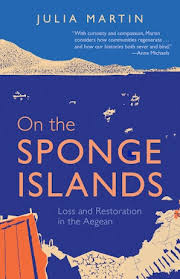
The Tripod studio recently welcomed author Julia Martin, whose books include On the Sponge Islands: Loss and Restoration in the Aegean, published last month by Trinity University Press. We covered a variety of topics during our conversation, but to keep within the time limit of a thirty-minute episode, we only briefly explored the gender roles woven throughout the islands’ history. I wanted to share a bit of what we discussed that didn’t make it into the episode.
The Greek islands of the Dodecanese, also known as the sponge islands, are located in the Aegean. Sponge diving is still done on the islands, but in the past it was an empire. Divers made the treacherous journey to the sea floor to farm sponges either by free-diving or by relying on gigantic metal suits to walk the ocean floor, similar to the ones you might see in cartoons. The men who made their fortunes sponge diving have received the most notoriety for their daring efforts, but the metal suit that allowed sponge diving to become a million-dollar industry was first worn by a woman.
Martin’s book opens with a chapter titled “Evgenia,” referring to the pregnant young woman who was brave enough to wear her husband-inventor’s metal diving suit to prove that it was safe. From that day on, the men were able to dive deeper, for longer, for more sponges and more profit, and the sponge industry was born. With its sudden popularity, many soon forgot Evgenia and the importance of women in the Dodecanese.
Since the sponge diving season lasted for half the year, women were left to run the island, care for their families, and ensure that their homes, farms, and livestock stayed safe while the men and young boys were away on the ocean. Many women remained responsible for everything they had on the island when their husbands, more often than not, did not come back alive.

After reading about this dynamic, I thought the islands must be plagued by toxic masculinity, but Martin brought up an interesting perspective from her visits. After speaking to veteran sponge divers and their families, she learned that though sponge diving was perilous, it was also revered. Men who had lost their friends, family, and limbs would gaze at the ocean and wish they could dive just one more time. Unlike so many other forms of labor that are fueled by toxic masculinity, sponge diving is akin to being an astronaut. You have the privilege of exploring a world beneath the waves that few have ever experienced. In addition, the profits the men brought home created a flourishing community that still holds evidence of its wealth.
So what do you think? Is sponge diving toxic or deserving of reverence? Decide for yourself after you listen to “The Sponge Islands: Heroes and History” and visit the Trinity University Press website to make your purchase of Julia Martin’s On the Sponge Islands: Loss and Restoration in the Aegean.
By Lily Brennan